Security support ends
After 9 December 2026, Drupal 10 no longer receives official security releases. Running D10 past that date means accepting unpatched core risk.
Drupal 10 reaches end of life on 9 December 2026 — the same week Drupal 12 ships. A Drupal 10 site cannot jump straight to Drupal 12; the supported path is Drupal 11 first.
IMADO helps teams decide and deliver: stay on Drupal with a planned upgrade to Drupal 11, or run a SEO-safe Drupal to WordPress migration before security support ends. Built for Drupal 10 site owners and marketing/IT leads deciding before 9 December 2026.
Get a Free Quote
Free proposal, no obligation. Fields marked * are required.
We’ve received your message and will get back to you shortly.
While you wait, feel free to explore:
10+ years
Web development since 2016
30+
5-star reviews on Clutch, Google & Sortlist
350+
completed projects
15+
long-term client relationships
Trusted by 60+ agencies and brands for launches, rebuilds and long-term support.






Stay on Drupal 11 when:
Consider WordPress when editorial speed, agency capacity and long-term maintenance cost matter more than staying in the Drupal stack — and you want a CMS your marketing team can run without specialized Drupal developers.
IMADO’s Drupal to WordPress migration maps content types, rebuilds templates and custom logic, and ships with redirect and SEO checks before go-live.
Use this decision view when Drupal 10 end of life forces a choice. Facts about dates come from Drupal.org; effort ranges depend on your module and content inventory.
| Decision factor | Upgrade to Drupal 11 | Migrate to WordPress |
|---|---|---|
| Platform after the move | Stay on Drupal (supported major) | Open-source WordPress CMS |
| Typical trigger | Drupal is strategic; stack is healthy | Lower ops cost, faster editorial, agency capacity |
| Drupal 10 EOL pressure | Must reach D11 before/around 9 Dec 2026 | Leave Drupal before support ends |
| Custom modules / features | Port or replace for D11 compatibility | Rebuild as themes, blocks, plugins or APIs |
| Content & media | In-place upgrade with staging | Mapped migration with QA on staging |
| SEO / URLs | Preserve; test after upgrade | Redirect map + metadata validation at launch |
| Team skills after launch | Drupal specialists still required | Broader WordPress talent pool |
| IMADO role | Advisory / selective rebuild help | Full migration delivery |
Drupal 10 end of life: 9 December 2026 (Drupal core release schedule). Drupal 12.0.0 is scheduled for the week of 7 December 2026; Drupal 10 cannot skip to 12.
Migration pricing depends on content types, multilingual setup and custom code. After a short audit you receive a scoped quote.
For Technical Teams
We speak your language - version control and performance budgets are part of our workflow. Every IMADO project follows modern engineering standards for scalability, maintainability, and long-term reliability.
All code is validated through PHP CodeSniffer (PHPCS) with WordPress Coding Standards (WPCS) rulesets applied. This ensures every commit meets consistent, high-quality standards - readable, maintainable, and fully aligned with WordPress core guidelines.
Our modular architecture allows content teams to manage flexible layouts safely - with reusable ACF or Gutenberg blocks following best coding and UX practices.
We use structured Git branching with pull requests, code review, and changelog documentation. Every project is version-controlled and auditable, keeping delivery transparent from start to deployment.
Strict input sanitization, escaping, and nonces ensure safe data handling. We apply least-privilege principles across user roles and API endpoints to minimize attack vectors.
Seamless integration with REST, GraphQL, and external APIs (CRM, ERP, booking, or payment systems) - built for stability and future scalability.
We work extensively with WooCommerce, LearnDash, Woo Subscriptions, WPML, Polylang, BuddyBoss, and other industry-standard plugins. From eCommerce to LMS and community platforms - we ensure smooth integration, scalability, and update safety.
The Gutenberg editor is WordPress’s modern, block-based editing system.
Instead of editing entire pages as one large piece of content, Gutenberg lets you build pages using individual blocks - such as headings, text, images, buttons, or custom components.
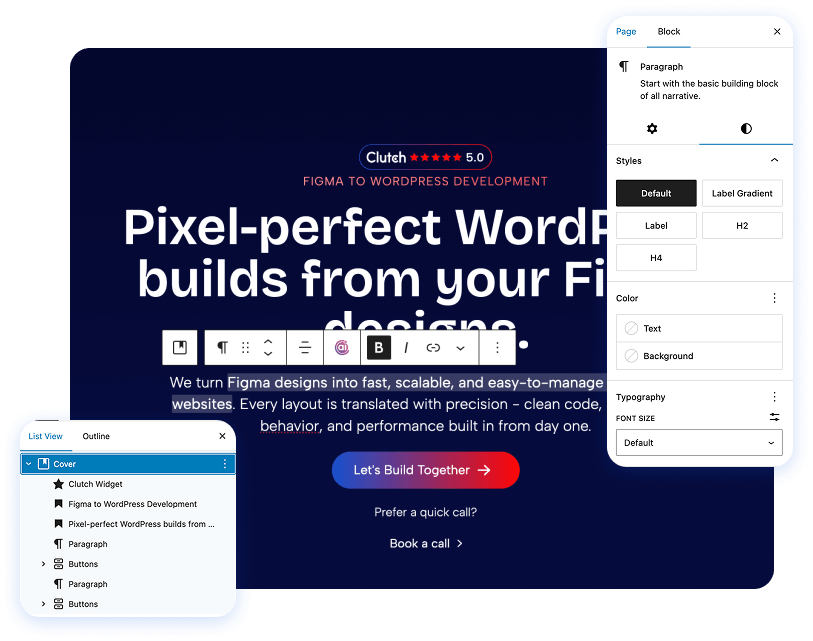
With Gutenberg, pages are built from structured blocks rather than hard-coded layouts. That means your team can update content without touching design or layout logic.
Each block represents a specific content element and can be edited, moved, or reused independently. This makes page management more intuitive, flexible, and significantly safer than traditional editors or page builders.
Drupal 10 end of life and Drupal to WordPress migration
Drupal 10 reaches end of life on 9 December 2026, according to the Drupal core release schedule. After that date, no new Drupal 10 releases are made. Drupal 12.0.0 is scheduled for the same week (week of 7 December 2026).
No. Drupal’s supported major-version path goes through Drupal 11. Sites on Drupal 10 need a Drupal 11 upgrade plan — or a move to another platform such as WordPress — before security support ends.
Upgrade to Drupal 11 when Drupal remains strategic and your modules/team are ready. Choose a Drupal to WordPress migration when you want lower specialized ops cost, faster editorial workflows and broader agency capacity. We can help you decide after a short audit.
That is the goal of our process: we protect URLs, metadata and internal linking with a redirect map and launch checklist. Results still depend on your starting SEO health and post-launch content operations.
Yes — functionality is rebuilt cleanly in WordPress (theme, blocks, plugins or integrations) rather than porting Drupal PHP modules as-is.
Yes, when architected correctly: custom content models, roles, multisite or multilingual setups, and performance/security hardening. It is not a drop-in theme swap.
Yes — maintenance and optimization services are available, including white-label care plans for agencies.
Yes — migration and redesign can be combined safely when the information architecture and redirect plan are agreed first.