
 Ask Chatgpt to summarize White Label Web Development Services: Boost Agency Profits
 Ask Grok to summarize White Label Web Development Services: Boost Agency Profits
 Ask Claude to summarize White Label Web Development Services: Boost Agency Profits
 Ask Perplexity to summarize White Label Web Development Services: Boost Agency Profits
 Ask Gemini to summarize White Label Web Development Services: Boost Agency Profits
Most agencies hit the same wall the same way. Sales keeps bringing in demand, account managers keep saying yes, and delivery starts to wobble. Deadlines slip, senior people get dragged into production, and profitable website work turns into a scheduling problem.
That’s where white label web development services stop being a convenience and start becoming an operating model. Used well, they let an agency sell strategy, UX, design, WordPress, WooCommerce, and ongoing support without building a large permanent development bench. Used badly, they create margin leaks, communication mess, and quality risk under your brand.
The difference is rarely the idea itself. It’s the structure behind it. Agencies that treat white label delivery as a strategic profit lever usually build better processes, hold cleaner scopes, and protect the client relationship with more discipline than agencies that treat it like overflow labor.
Why Smart Agencies Are Turning to White Label Partners
A lot of agencies don’t have a demand problem. They have a capacity problem.
You win a redesign project, then a WooCommerce brief lands the same week, then an existing client asks for landing pages, performance work, and ongoing maintenance. If your technical team is small, every new opportunity forces a bad choice. You either delay work, hire too early, or turn down projects you already know you could sell.
Capacity becomes a margin issue
This is why smart agencies increasingly use white label partners as a financial tool, not just a staffing patch. The global web design market was estimated at $61.23 billion in 2025, while the broader white label services market was forecast to hit $99.19 billion by 2026. The same industry guide notes that agencies commonly target 50% to 70% gross margins on white label work, often with a 2x to 3x markup over the partner’s cost, which makes the model commercially attractive when delivery is managed well (industry guide on white label web design economics).
That matters because payroll is fixed, but project flow isn’t. A white label partner lets you convert part of your delivery operation into variable capacity. When pipeline rises, you can absorb it. When work slows, you’re not carrying the same level of unused engineering overhead.
For agencies comparing operating models, this overview of the benefits of white label website design services is useful because it frames white label support as a way to widen service capacity without changing your front-end brand.
Practical rule: If a service is sellable but not consistently busy enough to justify a full in-house team, it’s usually a candidate for white label delivery.
The real gain is capability expansion
The strongest agencies don’t use white label partners only for overflow brochure sites. They use them to enter categories they couldn’t reliably deliver alone.
That can mean taking on a multilingual WordPress build, adding WooCommerce implementation to a design retainer, or packaging website maintenance into recurring revenue. The agency stays focused on positioning, client communication, scope control, and upsell strategy. The partner handles the specialist build work behind the scenes.
What works is simple. Keep strategy, discovery, and account ownership inside the agency. Use the partner to expand delivery capacity where technical depth is expensive to maintain internally. What doesn’t work is treating white label production like random subcontracting. That usually leads to inconsistent build quality and client-facing confusion.
Understanding True White Label Development
White label development looks simple from the outside, but most confusion starts with a bad definition.
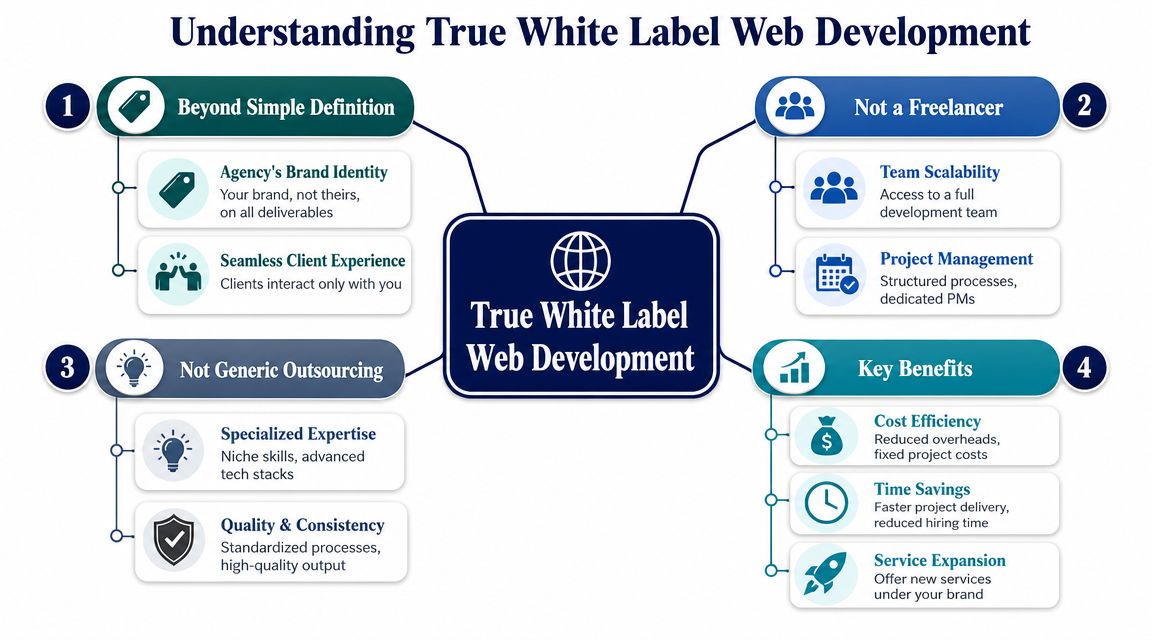
A freelancer can build a website for your client. An offshore team can also build it. Neither arrangement is automatically white label. True white label web development services are built around one principle: your client experiences the work as if it came entirely from your agency.
Think of it like a ghost kitchen
A useful analogy is a ghost kitchen. The customer orders from the restaurant brand they know. Another production team prepares the food behind the scenes. The customer doesn’t interact with the kitchen operator directly. They judge the restaurant.
That’s how a real white label build should work. The agency owns the relationship, proposal, pricing, timeline discussion, and feedback management. The development partner handles the invisible production layer.
If you want a plain-language breakdown of the operating model, this guide on understanding white label solutions and how they work is a useful companion.
What makes it different from ordinary outsourcing
The operational distinction matters more than the label. White-label development is distinct from outsourcing because the model is built around brand invisibility. The workflow runs through a documented handoff loop consisting of brief intake, partner-created mockups, agency review, client feedback relay, and final delivery. That structure preserves the agency’s UX, pricing, and support layer, and the client never communicates directly with the developer (Codeable’s explanation of white label workflow).
That last part is the line many agencies fail to hold. The moment a client starts talking directly to your “backend team,” you no longer have a true white label setup. You’ve introduced a second voice into the relationship, and with it, a second interpretation of scope, timeline, and responsibility.
Here’s the practical difference:
- Freelancer relationship: You may get good work, but continuity depends on one person’s availability and process discipline.
- Generic outsourcing vendor: You may get lower production costs, but client experience often feels detached from your agency’s standards.
- True white label partner: You get a defined handoff system that protects your brand while extending delivery capacity.
The client should never have to wonder who is actually building the project. If that question comes up, the delivery model is already leaking.
What the agency still owns
White label doesn’t remove management. It changes where management belongs.
Your team still has to do the hard parts that protect profitability:
- Qualify the project properly
- Write a clear brief
- Control revisions
- Translate client goals into implementation priorities
- Present work confidently under your brand
Agencies get into trouble when they assume the partner will compensate for poor scoping or weak project leadership. A strong partner can improve execution. They can’t rescue a vague proposal, a drifting stakeholder group, or a client who was sold the wrong thing.
What works is a clean split. The agency owns commercial and strategic control. The partner owns production execution. That’s how white label development should be structured when it’s done professionally.
Choosing Your White Label Delivery Model
Not every agency needs the same kind of partner involvement. One of the most expensive mistakes is using a full-project white label team for work that only needs a few hours of senior engineering. The reverse mistake is just as common. Trying to manage a large commerce build through ad hoc task support.
The delivery model should match the type of demand you have.
Three models agencies use most
The first model is on-demand engineering. This works when you need a developer for specific fixes, sprint support, code reviews, plugin conflicts, performance issues, or launch support. It’s ideal when your internal team can manage the project but needs specialist execution in narrow areas.
The second is staff augmentation. Here, the developer functions like an embedded extension of your team. Your project manager, lead strategist, or internal technical lead still runs the work. The partner supplies development capacity that follows your systems and meetings.
The third is full white label project delivery. This fits agencies that want to sell complete web projects under their own brand while outsourcing most of the execution layer. The agency keeps client control, but the partner handles a larger share of mockups, development, testing, and launch preparation.
White Label Delivery Model Comparison
| Model | Best For | Cost Structure | Management Overhead |
|---|---|---|---|
| On-demand engineering | Bug fixes, small feature work, launch support, specialist tasks | Usually hourly or task-based | Low to moderate |
| Staff augmentation | Ongoing sprint work, internal team support, embedded capacity | Usually recurring time allocation or hourly billing | Moderate |
| Full white label builds | Entire website projects, WooCommerce launches, redesigns, migrations | Usually fixed-bid, milestone-based, retainer, or blended pricing | Moderate to high on agency side, lower on production side |
When each model makes financial sense
Use on-demand engineering when speed matters more than process depth. If a client site has a checkout bug, a broken template, or a plugin conflict, you don’t need a broad production team. You need a capable engineer who can enter, diagnose, fix, test, and document the change.
Use staff augmentation when your sales engine is healthy and your project management discipline is already strong. This model works best when your agency has a repeatable way of running design and development but needs more hands to keep throughput stable.
Use full white label delivery when your brand is strong on the front end and your technical bench is intentionally lean. This is often the cleanest path for agencies that sell websites regularly but don’t want to build a large in-house engineering department.
The wrong model usually shows up as excess management. If your account team is spending too much time translating basic tasks, the structure is off.
Decision criteria that matter more than price
Price matters, but it’s rarely the deciding factor in a good agency model. Four questions usually tell you which setup is right:
- How defined is the scope? Fixed projects suit full white label builds. Unclear or changing work often fits hourly support better.
- Who is managing technical decisions? If that stays in-house, augmentation can work well. If not, use a partner with broader delivery ownership.
- How often does this work type appear? Repeated demand may justify a recurring arrangement. Irregular demand usually favors flexible access.
- How visible is delivery risk to the client? High-stakes launches need stronger process and clearer QA ownership.
There’s also a platform decision underneath the delivery decision. If you’re helping clients compare simpler site creation against more custom implementation, this own.page comparison of no-code website builders and traditional websites is worth reviewing. It’s useful early in the sales process because the right build approach affects which white label model is commercially sensible.
A common mistake to avoid
Many agencies start with augmentation when they actually need a full white label process. They assume adding a developer will solve the problem. It often doesn’t.
If your team is already weak on technical scoping, QA, or deployment planning, an embedded developer won’t fix the underlying operating gap. In that case, buying a more complete production system is safer and often more profitable, even if the headline delivery cost looks higher.
Core Capabilities Your Partner Must Have
A cheap developer is easy to find. A partner who helps you sell better projects is much harder to find.
That’s the right standard. You’re not buying code alone. You’re buying the ability to say yes to work that would otherwise be risky, slow, or outside your current bench strength.
Breadth matters, but depth matters more
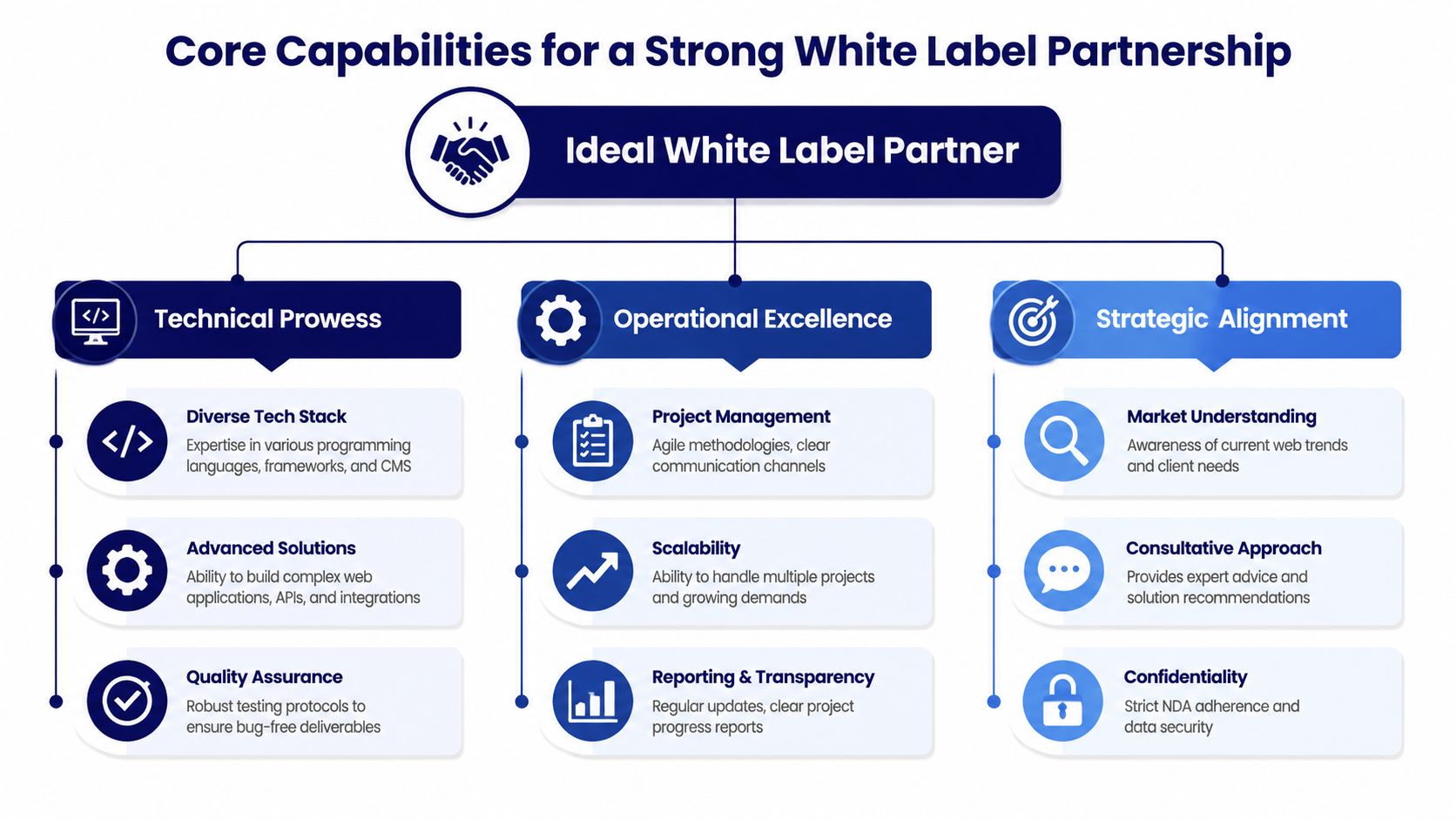
Mature white-label partners now support full-stack builds, including WordPress, WooCommerce, and modern frameworks. That broader stack coverage plus post-launch support allows agencies to sell higher-margin retainers and more complex engagements such as multilingual sites, API integrations, and conversion-optimized checkout flows without building every specialty in-house (overview of full-stack white label capability).
That sounds broad, but in practice you should evaluate a partner on a small number of high-value capabilities.
WordPress architecture
A serious partner should be comfortable with more than page-builder assembly. For agency work, that usually means custom themes, Gutenberg or full-site editing workflows, plugin conflict handling, template logic, editorial permissions, and structured content models that can scale.
If they can only build inside a narrow theme setup, your service offering becomes narrow too.
WooCommerce delivery
Commerce work exposes weak partners fast. Product complexity, tax logic, payment handling, shipping rules, and checkout UX create more edge cases than a standard marketing site.
Look for teams that can handle:
- Custom checkout logic: Especially when clients need specific purchase flows or field handling.
- Platform integrations: ERP, CRM, inventory, shipping, and payment system connections matter more than visual polish on many stores.
- Performance under load: Catalog size, filtering, cart interactions, and script weight all affect buying experience.
- Post-launch care: Commerce sites need maintenance discipline because failures show up immediately in revenue operations.
The capabilities that lift project value
Some technical skills are directly tied to stronger agency positioning.
A partner with multisite and multilingual experience can support franchise groups, regional brands, and multi-market content operations. A partner with API integration experience can connect the website to the rest of the client’s business, which usually pushes the engagement above simple brochure-site pricing. A partner with headless or decoupled architecture experience can support cases where editorial flexibility, performance strategy, or app-like front-end behavior matters.
One relevant option in this category is IMADO’s white label WordPress development service, which is built around WordPress engineering, WooCommerce, multilingual and multisite setups, headless builds, API integrations, and ongoing maintenance.
Agencies should judge technical capability by what it lets them sell, not by how many tools appear on a partner’s service page.
Maintenance is part of the product
A lot of agencies still separate “the build” from “the support.” Operationally, that’s a mistake.
If your partner can’t support updates, bug triage, monitoring, performance work, and controlled improvement after launch, you lose one of the most profitable parts of the model. Maintenance isn’t an afterthought. It’s where recurring revenue, client stickiness, and technical trust usually deepen.
A partner doesn’t need to offer every possible stack. They do need to be strong in the stack your clients buy. For many agencies, that means WordPress and WooCommerce first, then adjacent capabilities that increase average project value and reduce the number of deals you have to decline.
The Vetting Process A Checklist for Agencies
Most partner mistakes happen before the first project starts. Agencies hire from presentations, portfolios, and friendly calls, then discover the actual problems during QA, launch, or revision cycles.
A proper vetting process should feel closer to operational due diligence than vendor shopping.
What to inspect before you trust them with client work
Start with technical proof, but don’t stop there.
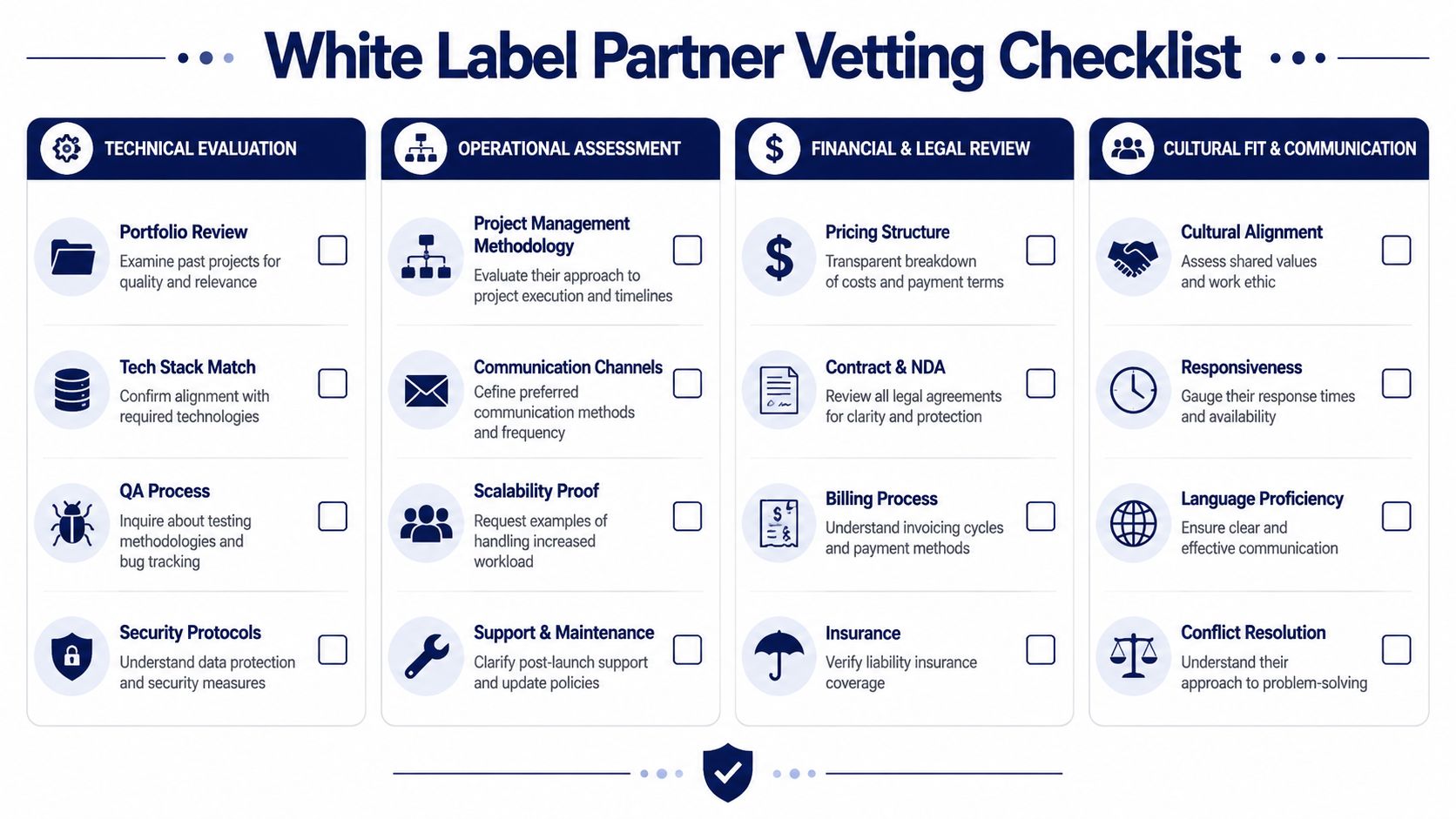
- Ask for code samples, not just screenshots: A polished homepage doesn’t tell you how they structure templates, handle fields, or manage technical debt.
- Review relevant project types: If you sell WooCommerce, inspect WooCommerce work. If you sell multilingual WordPress, ask for examples in that category.
- Check the QA process: Ask how they test responsive behavior, browser differences, form handling, checkout paths, and regression risk.
- Verify security habits: You need to know how they handle access, staging, credentials, plugin updates, and issue escalation.
A portfolio wins interest. Process wins trust.
Operational fit decides whether the work feels easy
The second layer, workflow compatibility, is a common failure point for many otherwise capable partners.
Ask direct questions about how they run projects inside tools like Slack, Jira, Asana, Trello, ClickUp, GitHub, or GitLab. You’re not looking for a specific app stack as much as evidence that they work from a repeatable delivery system.
Use this checklist:
Communication rhythm
How often do they update? Who owns status reporting? What happens when a blocker appears?Timezone overlap
You don’t need perfect overlap, but you do need dependable handoff windows.Escalation path
If a launch breaks, who responds, how quickly, and through what channel?Revision handling
Ask how they distinguish bug fixes, missed requirements, and new scope.
For agencies that need extra senior support during this evaluation stage, bringing in a WordPress expert for hire can help pressure-test technical proposals and uncover weak assumptions before you commit.
A good partner makes project status boring. If updates are vague before the contract is signed, they’ll be worse after it.
A short walkthrough on what to examine during due diligence can also help frame internal discussions:
Questions worth asking references
When you speak to references, don’t ask whether they were happy. Ask where things got difficult.
Useful questions include:
- Where did communication slow down?
- How did they behave when scope changed?
- Did they catch issues before launch, or did you find them?
- Would you trust them on a project with your top client? Why or why not?
Those answers tell you more than generic praise. Good references can usually describe both strengths and friction points clearly. That balance is a positive sign. It means the relationship was real, not staged.
Structuring the Partnership for Success
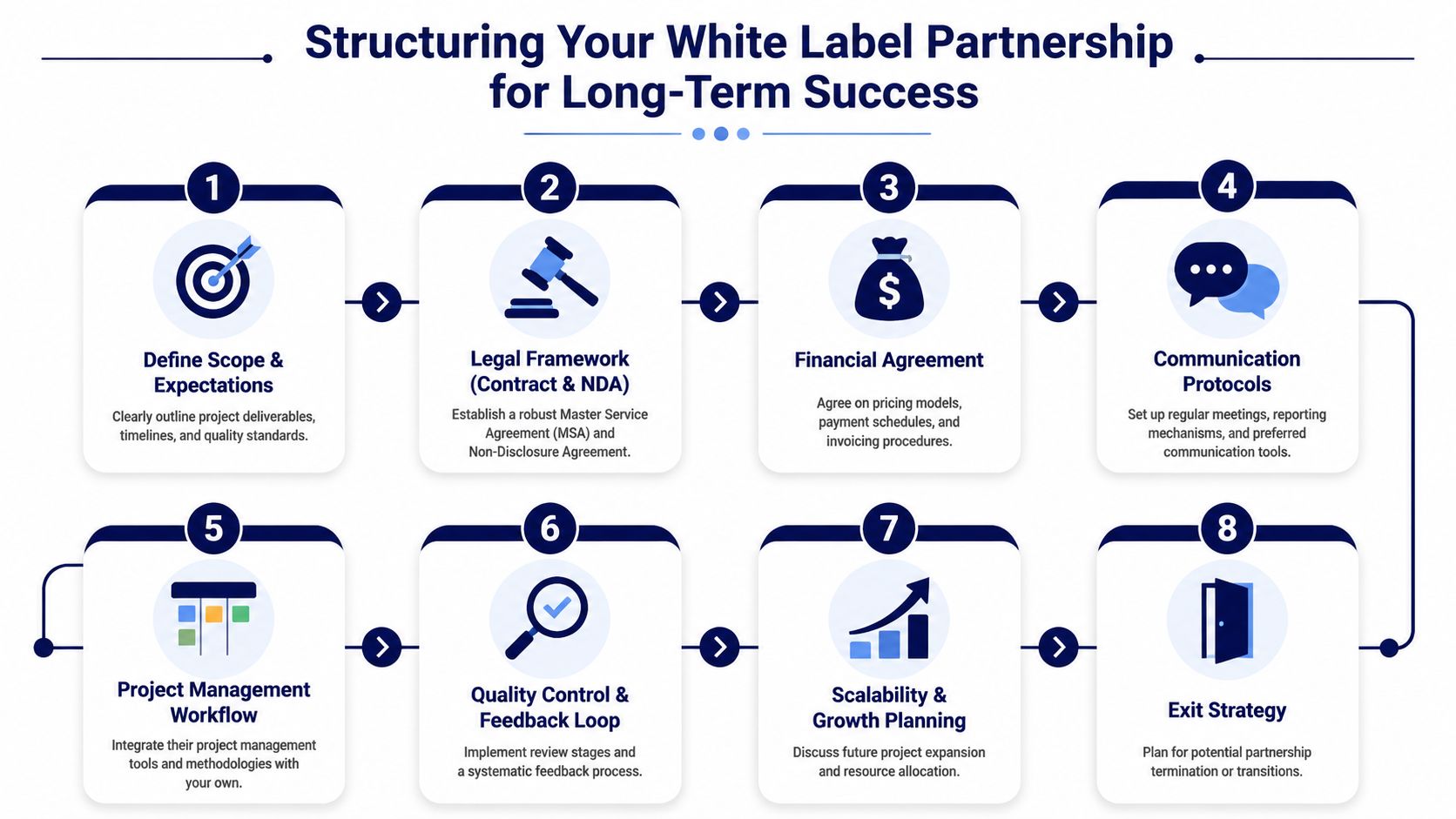
A strong partner can still become a weak arrangement if the commercial and legal structure is sloppy. In such cases, agencies either protect margin or slowly give it away through vague scope, unclear ownership, and support obligations nobody priced properly.
The partnership should be built like a delivery system, not a handshake.
Pick the right pricing model for the work
Industry data shows typical white label website development pricing ranges from about $1,500 per month for 15 to 20 development hours, with project-based WordPress work commonly falling between $500 and $5,000+, and hourly rates generally around $25 to $75. Those benchmarks are useful when you’re building a fair and sustainable partnership structure (white label pricing benchmarks for agencies).
The important part isn’t the benchmark itself. It’s choosing a model that matches scope behavior.
Fixed bid
Best when the deliverables are clear, the revision path is controlled, and dependencies are known early. Good for brochure sites, defined landing page batches, and tightly scoped rebuilds.
Bad fit for evolving product requirements or stakeholder-heavy organizations.
Hourly or time-based support
Best for bug fixing, iterative enhancement, technical debt cleanup, or discovery-led work where requirements sharpen over time.
Bad fit when clients expect a hard project total before requirements are stable.
Retainer
Best when you want predictable capacity across maintenance, feature requests, optimization, and support. Retainers work well when the agency has recurring client demand but irregular task volume from month to month.
Bad fit if the agency has no process for using reserved hours consistently.
Contract terms that should never be vague
A proper agreement needs more than pricing.
- Intellectual property ownership: The final code, assets, and deliverables should transfer in a way that supports your agency’s client contracts.
- Confidentiality and NDA terms: White label only works if invisibility is contractual, not assumed.
- Liability boundaries: Everyone needs clarity on what happens if a defect, delay, or third-party failure causes downstream issues.
- Support windows and SLAs: Define what counts as a bug, what counts as new scope, and what response standards apply after launch.
- Termination and transition terms: If the relationship ends, access, documentation, repositories, and handoff responsibilities should already be defined.
Operating principle: If a repeated scenario isn’t documented, it will be argued about later.
The onboarding process should be standardized
Agencies often underestimate onboarding because it feels administrative. It isn’t. It determines whether the partner can mirror your delivery standards.
A useful onboarding sequence usually includes:
Brand and communication briefing
Tone, presentation style, meeting norms, file naming, documentation expectations.Technical standards
Preferred stack, repository flow, coding standards, staging approach, QA checkpoints.Commercial rules
Approval thresholds, change request handling, estimate format, invoicing rhythm.Client delivery framework
Who presents mockups, who gathers feedback, who signs off on readiness for launch.
Reporting should protect both sides
You don’t need bloated reporting. You need reporting that makes risk visible early.
The best operating cadence is usually simple:
| Reporting area | What should be visible |
|---|---|
| Scope status | What is in, what changed, what is pending approval |
| Delivery status | What is done, in progress, blocked, and ready for review |
| Risk log | Issues that could affect timeline, budget, or quality |
| Support status | Open bugs, maintenance actions, unresolved dependencies |
When agencies skip this discipline, they usually discover problems too late. Scope has drifted, revisions are piling up, and delivery cost no longer supports the margin they sold.
A white label partnership becomes profitable when both sides can see the same project clearly. That clarity is contractual, operational, and financial.
Conclusion Building Your Agency’s Future
White label web development services work best when you stop thinking of them as overflow help.
They’re a way to redesign how your agency delivers technical work. You keep the client relationship, the positioning, the commercial strategy, and the creative direction. A specialist partner gives you the production depth to sell more confidently, handle more complexity, and avoid turning payroll into the only path to growth.
That shift changes more than capacity. It changes what kinds of business you can pursue. Agencies with the right white label structure can move into larger WordPress builds, more demanding WooCommerce work, multilingual or integration-heavy projects, and recurring support without trying to hire every specialist role in-house.
The model still needs discipline. Poor scoping, weak communication, and vague contracts will damage a white label arrangement just as quickly as they damage an internal team. But when the partner is vetted carefully and the operating framework is clean, white label delivery becomes one of the simplest ways to expand capability while protecting margin.
For most agencies, the next move isn’t hiring blindly or outsourcing randomly. It’s reviewing your current pipeline and asking better questions. Which projects strain your team? Which services sell well but create delivery friction? Which offers could become more profitable if production capacity were flexible instead of fixed?
Those answers usually point to the right model quickly.
If your agency needs a quieter, more scalable way to deliver WordPress and WooCommerce work under your own brand, IMADO is one option to evaluate. The team provides white-label delivery, on-demand engineering, staff augmentation, and ongoing maintenance for agencies that want senior technical execution without expanding headcount.
Let’s build something exceptional
Tell us about your project – we’ll help you launch a fast, scalable, SEO-optimized WordPress platform built for growth.